
Criminal Law in the USA: Charges, Defenses, Penalties & Rights
Facing a criminal charge can be confusing and stressful. You may not know what the charge means, what could happen next, or whether you need a lawyer. Even a relatively minor charge can affect your record, employment, education, housing, and future opportunities.
Criminal law covers offenses that the government considers harmful to individuals, property, or public safety. These cases are different from civil lawsuits because the government prosecutes the person accused of committing a crime.
The good news is that being arrested or charged does not automatically mean you are guilty. The prosecution generally has to prove the required elements of the offense beyond a reasonable doubt.
Understanding the basic criminal justice process can help you make informed decisions. This guide explains common types of criminal charges, how cases move through court, possible defenses and penalties, and practical steps to take if you are accused of a crime.
What Is Criminal Law?
Criminal law is the area of law dealing with conduct that has been prohibited by federal or state law. Depending on the offense, a person may face consequences such as probation, fines, community service, or incarceration.
Criminal cases are generally brought by the government rather than by the alleged victim personally.
For example, if someone is accused of stealing property, the state may bring a theft prosecution. The property owner can provide information and cooperate with investigators, but the government usually controls the criminal case.
The exact definition and punishment for an offense can vary significantly between states.
Criminal Law vs. Civil Law
Criminal and civil cases serve different purposes.
| Criminal Case | Civil Case |
|---|---|
| Usually brought by the government | Usually brought by an individual or organization |
| Involves alleged criminal conduct | Usually involves a dispute over rights, money, property, or other interests |
| Possible jail or prison sentence | Usually involves money damages or court orders |
| Higher burden of proof | Generally lower burden of proof |
| Defendant may have constitutional protections specific to criminal proceedings | Different procedural protections generally apply |
One incident can sometimes lead to both criminal and civil proceedings.
For example, a person accused of causing an injury through unlawful conduct could face a criminal prosecution while the injured person separately pursues compensation through a civil lawsuit.
Common Types of Criminal Charges
Criminal offenses cover a wide range of conduct. Some are relatively minor, while others can result in severe penalties.
Misdemeanors
Misdemeanors are generally less serious offenses than felonies, although the consequences can still be significant.
Examples may include certain forms of:
- Simple assault
- Disorderly conduct
- Minor theft
- Certain traffic-related crimes
- Some property offenses
- Some first-time alcohol-related offenses
The maximum punishment depends on the applicable state or federal law.
A misdemeanor conviction can still create a criminal record and may affect employment, professional licensing, immigration matters, or other areas of life.
Felonies
Felonies are generally more serious crimes and can carry substantial penalties.
Examples can include:
- Robbery
- Certain serious drug offenses
- Burglary
- Serious violent offenses
- Certain sex offenses
- Major fraud offenses
- Some weapons offenses
Not every offense is classified the same way in every state. Some crimes can also be charged at different levels depending on factors such as the alleged conduct, prior convictions, amount of property involved, or whether someone was injured.
Federal Crimes
Most criminal cases are handled under state law, but certain conduct falls under federal jurisdiction.
Federal prosecutions can involve matters such as specific forms of fraud, certain drug trafficking offenses, federal tax crimes, crimes involving federal property, and offenses crossing state or international boundaries.
Federal criminal procedure can differ from state court procedure, so someone facing federal charges should understand which court has jurisdiction over the case.
How a Criminal Case Usually Starts
A criminal case can begin in several ways.
Police may investigate an alleged offense and make an arrest. In other situations, prosecutors may file charges after reviewing evidence collected by investigators.
Depending on the jurisdiction and circumstances, a person may receive a summons, appear voluntarily, or be arrested.
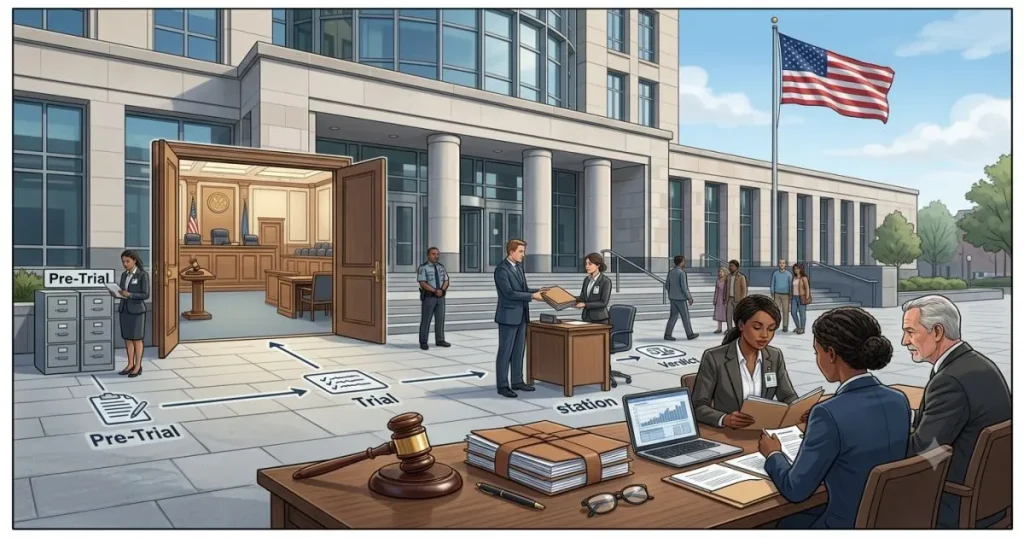
The process often includes several stages.
Investigation
Law enforcement may interview witnesses, review records, collect physical evidence, examine digital information, or use other lawful investigative methods.
Being investigated does not necessarily mean that charges will be filed.
Arrest or Citation
If authorities believe they have sufficient legal grounds, they may arrest a suspect or issue a citation for certain offenses.
An arrest itself is not proof of guilt.
Initial Court Appearance
The accused person generally appears before a judge. The court may address issues such as the charges, legal representation, release conditions, and future court dates.
Arraignment
In many cases, an arraignment is where the defendant is formally informed of the charges and enters a plea.
Common pleas include:
- Guilty
- Not guilty
- No contest, where permitted
The exact procedure varies by jurisdiction.
Pretrial Proceedings
Before trial, both sides may deal with evidence, motions, witness issues, plea negotiations, and other legal questions.
Some cases are resolved during this stage rather than going to trial.
Trial
If the case proceeds to trial, the prosecution presents evidence intended to prove the charges.
The defense can challenge the prosecution’s evidence and present a defense when appropriate.
In a jury trial, jurors generally decide whether the prosecution has proved guilt beyond a reasonable doubt.
Sentencing
If a defendant is convicted or enters a guilty plea, the court may impose a sentence based on applicable law and the circumstances of the case.
Possible consequences vary widely.
What Does “Beyond a Reasonable Doubt” Mean?
The burden of proof in a criminal prosecution is generally much higher than in an ordinary civil case.
The prosecution must prove the required elements of the offense beyond a reasonable doubt.
This does not mean that the government must eliminate every imaginable doubt. Instead, the standard requires a very high level of certainty before a criminal conviction can be entered.
This burden is one of the central protections in the American criminal justice system.
Criminal Defenses: What Can a Defendant Argue?
A defense depends on the facts, evidence, and specific charge.
A lawyer may examine whether the prosecution can prove every required element of the alleged offense.
Possible defenses or legal arguments may include:
Mistaken Identity
The accused may argue that they were not the person who committed the alleged offense.
This can involve examining identification procedures, surveillance footage, witnesses, digital records, or other evidence.
Self-Defense
In some circumstances, a person may legally use reasonable force to protect themselves or another person from an unlawful threat.
Self-defense laws differ substantially between states, including rules concerning when force is justified.
Lack of Intent
Some crimes require proof of a particular mental state.
If the prosecution cannot establish the required intent or knowledge, that may be important to the defense.
Insufficient Evidence
The prosecution must prove the elements of the charged offense.
If the evidence does not meet the required legal standard, the defense may challenge the case.
Constitutional Violations
Law enforcement generally must follow constitutional and statutory requirements.
Depending on the circumstances, issues involving unlawful searches, improper questioning, identification procedures, or other violations may affect whether certain evidence can be used.
These issues are highly fact-specific and should be reviewed by a qualified attorney.
Possible Criminal Penalties
The consequences of a conviction depend on the offense, jurisdiction, criminal history, and other circumstances.
Possible penalties may include:
- Fines
- Probation
- Community service
- Restitution
- Counseling or treatment requirements
- Driver’s license consequences
- Jail
- Prison
- Restrictions connected to certain convictions
Some convictions may also create long-term consequences outside the courtroom.
For example, a criminal record can potentially affect employment applications, professional licensing, educational opportunities, housing, and other areas.
Plea Bargains and Criminal Cases
Many criminal cases are resolved through plea agreements rather than a trial.
A plea bargain may involve the defendant agreeing to plead guilty or no contest in exchange for an agreed recommendation, reduced charge, dismissal of certain charges, or another concession, depending on the case and jurisdiction.
However, a plea agreement is an important legal decision.
Before accepting one, a defendant should understand:
- The exact charge involved.
- The proposed sentence or sentencing recommendation.
- Whether the agreement includes probation or other conditions.
- Whether the conviction creates additional legal consequences.
- What rights are being given up by entering the plea.
- Whether immigration or professional consequences may apply.
A defense attorney can explain the risks and potential benefits based on the specific case.
Common Mistakes After an Arrest
People sometimes make decisions after an arrest that make their situation harder.
Talking Too Much About the Case
Statements made to police, other people, or online can potentially become evidence.
It is generally wise to avoid discussing the facts of an active criminal case publicly and to ask an attorney for advice.
Posting on Social Media
Social media posts, photographs, videos, and messages can become relevant to an investigation or court case.
Avoid using social media to argue about the case or attack witnesses, police officers, prosecutors, or the alleged victim.
Ignoring Court Dates
Missing a required court appearance can create additional legal problems.
Keep track of every court date and follow release conditions carefully.
Assuming the Charge Will Automatically Disappear
Some people believe that an arrest automatically disappears if they were not convicted. Rules concerning records, sealing, and expungement vary by jurisdiction.
Do not assume a record will be removed without checking the applicable law.
Choosing a Lawyer Based Only on Price
Cost matters, but experience with the relevant type of criminal case also matters.
Ask potential attorneys about their experience, communication practices, fees, and approach to your particular situation.
How to Choose a Criminal Defense Lawyer
If you are facing criminal charges, choosing the right lawyer can be an important decision.
Look for an attorney who:
- Is licensed to practice in the relevant jurisdiction.
- Handles criminal defense cases.
- Has experience with the type of charge involved.
- Clearly explains your legal options.
- Communicates in a way you understand.
- Provides clear information about fees.
- Does not promise a guaranteed result.
Be cautious of anyone who guarantees that a case will be dismissed or promises a specific outcome.
No responsible attorney can guarantee the result of a criminal case.

Pros and Cons of Hiring a Criminal Defense Lawyer
Hiring a lawyer is not a guarantee of success, but professional legal representation can provide valuable assistance.
| Potential Benefits | Possible Drawbacks |
|---|---|
| Helps explain the charges | Legal fees can be expensive |
| Reviews evidence and legal issues | Communication may take time |
| Handles court procedures | Results cannot be guaranteed |
| Negotiates with prosecutors when appropriate | Some decisions remain with the defendant |
| Helps protect legal rights | Complex cases may take months or longer |
For serious charges, the potential consequences can be substantial. That makes getting qualified legal advice especially important.
People who cannot afford private representation may have options for appointed counsel, depending on the case and applicable law.
What Should You Do After Being Charged?
If you are accused of a crime, focus on protecting your legal rights and avoiding unnecessary mistakes.
1. Take the Charge Seriously
Do not assume that a charge will simply disappear.
Find out exactly what offense you are accused of and which court is handling the case.
2. Follow All Court Conditions
If you are released, carefully follow every condition imposed by the court.
Violating release conditions can create additional problems.
3. Keep Your Documents
Save paperwork related to the arrest, citation, court dates, bond, release conditions, and communications from your attorney.
Organized records can make discussions with your lawyer easier.
4. Avoid Discussing the Case Publicly
Do not post detailed explanations of your case online.
Even an innocent attempt to tell your side of the story can create complications.
5. Speak With a Qualified Attorney
A lawyer can review the facts and explain options specific to your jurisdiction.
If you have not been charged but believe you are under investigation, legal advice may also be useful before speaking with investigators.
Frequently Asked Questions About Criminal Law
What is criminal law?
Criminal law governs conduct that federal, state, or sometimes local governments have defined as criminal offenses. It also establishes procedures and potential penalties for those offenses.
What is the difference between a misdemeanor and a felony?
A felony is generally a more serious offense than a misdemeanor and can carry more severe penalties. However, classifications and punishment vary by jurisdiction and by the specific offense.
Does being arrested mean I am guilty?
No. An arrest or criminal charge is not the same as a conviction. The prosecution generally must prove the required elements of the offense beyond a reasonable doubt.
Do I need a lawyer for a criminal charge?
It depends on the circumstances, but speaking with a qualified criminal defense attorney can help you understand the charge, possible consequences, deadlines, and available legal options.
Can criminal charges be dismissed?
Some cases are dismissed for different legal or factual reasons, but there is no automatic rule that applies to every case. A prosecutor, judge, or court process may be involved depending on the circumstances and jurisdiction.
What happens if I plead guilty?
A guilty plea generally means accepting responsibility for the charged offense and giving up certain trial-related rights. The consequences depend on the agreement, charge, and applicable law.
Can a criminal record be removed?
Some jurisdictions allow certain records to be sealed, expunged, or otherwise restricted under specific conditions. Eligibility and procedures vary significantly by state and offense.
Final Thoughts
Criminal charges should never be treated casually. The possible consequences can extend beyond fines or incarceration and may affect employment, education, housing, licensing, and other parts of life.
The most important step is to understand exactly what you are accused of and what law applies to your situation. Keep your court documents organized, follow every court requirement, avoid discussing the case publicly, and seek advice from a qualified attorney when appropriate.
Most importantly, remember that criminal cases are highly dependent on the facts and the jurisdiction. A general online article cannot replace legal advice about your individual circumstances.
If you or someone you know is facing a criminal charge, getting reliable information early can help you make better decisions throughout the legal process.