

Attorney vs Lawyer: What’s the Difference and Which One Do You Need?
If you have ever searched for legal help, you have probably seen the words attorney and lawyer used almost interchangeably. That can make a simple question surprisingly confusing: Is an attorney different from a lawyer?
In the United States, the two terms often refer to the same type of legal professional. However, there is a small distinction in how the words are technically used.
Understanding that difference can help you make better decisions when looking for legal representation. Whether you need help with a contract, personal injury claim, divorce, business matter, criminal charge, or estate plan, knowing what legal professional you are hiring matters.
This guide explains attorney vs lawyer in simple terms, including what each term means, what they can do, how they become licensed, and what to consider before hiring one.
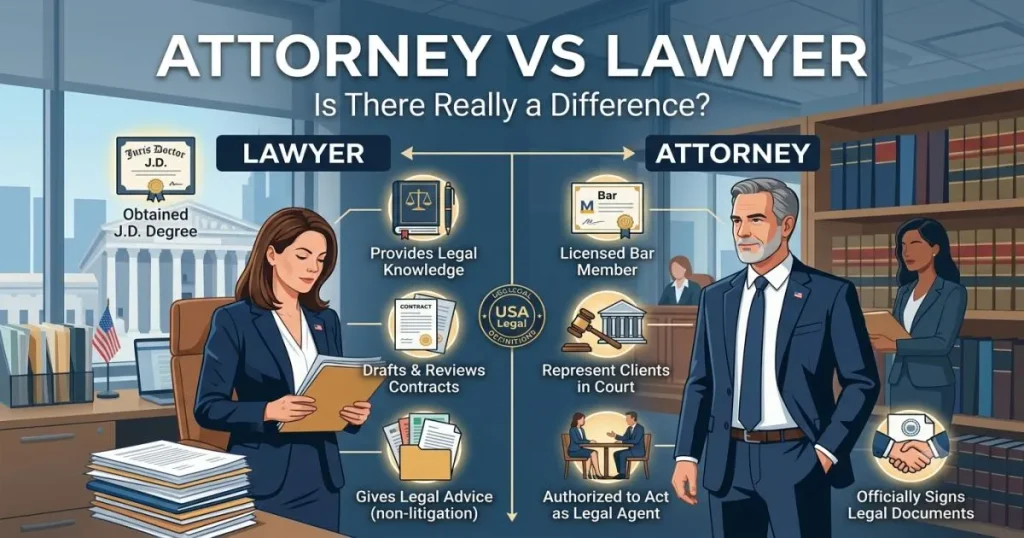
What Is a Lawyer?
A lawyer is generally a person who has completed legal education and earned a law degree, usually a Juris Doctor (J.D.) in the United States.
After completing law school, a person normally needs to meet the requirements of a state bar before they can practice law in that jurisdiction.
The word “lawyer” is broad. It can describe someone who has legal training, although the exact legal definition can vary by state and context.
For example, someone with a law degree may work in:
- A private law firm
- A government agency
- A corporation
- A nonprofit organization
- A court-related position
- Academia
- Legal research
Not every person with legal training represents clients in court.
What Does a Lawyer Do?
A lawyer’s work depends heavily on their area of practice.
Common legal services include:
- Giving legal advice
- Reviewing contracts
- Preparing legal documents
- Negotiating agreements
- Representing clients in legal disputes
- Researching laws and regulations
- Helping businesses with compliance
- Handling estate planning matters
- Advising clients about legal rights and obligations
For example, a business lawyer may review an employment agreement, while a personal injury lawyer may help a client pursue compensation after an accident.
What Is an Attorney?
An attorney is commonly understood in the United States as a lawyer who is authorized to practice law and represent clients.
The term comes from the concept of being an “attorney at law.” In everyday American English, however, attorney and lawyer are frequently used to mean essentially the same thing.
An attorney may:
- Represent a client
- Appear in court
- Negotiate on a client’s behalf
- Prepare legal documents
- Provide legal advice
- Handle legal proceedings
- Communicate with opposing counsel
The important point is that being licensed to practice law is different from simply having studied law.
Attorney vs Lawyer: What’s the Difference?
When comparing attorney vs lawyer, the practical difference in the United States is usually very small.
Both terms are commonly used to describe legal professionals who have completed the necessary education and are licensed to practice law.
The word “attorney” often emphasizes the person’s role as someone who acts on behalf of a client.
The word “lawyer” is broader and is commonly used in everyday conversation to describe someone trained in law.
| Feature | Lawyer | Attorney |
|---|---|---|
| Legal education | Usually required | Usually required |
| Law degree | Typically J.D. in the U.S. | Typically J.D. in the U.S. |
| Bar admission | Needed to practice law | Needed to practice law |
| Can provide legal services? | If properly licensed | If properly licensed |
| Can represent clients? | If authorized | If authorized |
| Court representation | Depending on license and jurisdiction | Depending on license and jurisdiction |
| Common usage | Very common | Very common |
| Practical difference | Usually little | Usually little |
In everyday U.S. legal conversations, you generally do not need to worry about choosing someone because of the word “attorney” versus “lawyer.”
Instead, focus on whether the person is properly licensed and has experience with your particular legal issue.
How Does Someone Become a Lawyer or Attorney in the USA?
Becoming a licensed legal professional in the United States requires several steps.
The exact process varies by state, but the general path looks like this.
1. Complete an Undergraduate Degree
A person normally completes a bachelor’s degree before attending law school.
Unlike some professional programs, U.S. law schools generally do not require one specific undergraduate major.
Students may study subjects such as history, political science, economics, business, English, or other fields.
2. Attend Law School
The next major step is earning a law degree.
Most practicing lawyers in the United States earn a Juris Doctor (J.D.) from an accredited law school.
Law school typically includes subjects such as:
- Contracts
- Constitutional law
- Civil procedure
- Criminal law
- Property law
- Legal writing
- Evidence
Students may also take specialized courses based on their interests.
3. Pass the Bar Exam
After law school, candidates generally must satisfy their state’s requirements for admission to the bar.
In many states, this includes passing a bar examination.
The licensing process may also include other requirements, such as a character and fitness review.
4. Receive Authorization to Practice
Once all state requirements are satisfied, the person can become licensed to practice law in that jurisdiction.
This is an important distinction for consumers.
A person can have legal education without being authorized to provide legal services to the public in the same way a licensed attorney can.
Can Lawyers and Attorneys Go to Court?
Yes, a properly licensed attorney can generally represent clients in court, subject to the rules of the relevant jurisdiction and court.
However, not every lawyer spends time inside a courtroom.
Some legal professionals focus almost entirely on matters outside litigation.
For example, a lawyer may spend most of their time:
- Drafting contracts
- Advising businesses
- Preparing estate documents
- Negotiating deals
- Reviewing regulations
- Handling real estate transactions
This is why you should not assume that every lawyer is a courtroom trial lawyer.
Different Types of Lawyers and Attorneys
Legal professionals often specialize in particular areas of law.
Personal Injury Lawyer
A personal injury lawyer may help people who have been injured because of another party’s negligence or wrongful conduct.
Cases can involve car accidents, workplace injuries, premises liability, and other disputes.
Criminal Defense Attorney
A criminal defense attorney represents people facing criminal allegations.
Their work can include reviewing evidence, explaining legal options, negotiating with prosecutors, and representing clients during criminal proceedings.
Family Lawyer
Family lawyers handle legal matters involving relationships and families.
Examples include:
- Divorce
- Child custody
- Child support
- Adoption
- Property disputes
Business Attorney
Business attorneys help companies deal with legal issues.
They may work on:
- Business formation
- Contracts
- Employment matters
- Regulatory compliance
- Business disputes
- Mergers and acquisitions
Estate Planning Lawyer
Estate planning lawyers help clients prepare documents concerning the management and distribution of assets.
Common documents can include wills, trusts, powers of attorney, and related planning documents.
Employment Lawyer
Employment lawyers may advise employers or employees about workplace-related legal issues.
These matters can involve employment contracts, workplace disputes, discrimination claims, wage issues, and other employment laws.
Do You Need an Attorney or Lawyer?
In most situations, the bigger question is not whether you need an “attorney” or a “lawyer.”
The better question is:
Do you need a licensed legal professional with experience in your specific type of matter?
Legal help may be useful when:
- You are facing a lawsuit
- You have received legal papers
- You are considering filing a lawsuit
- You are negotiating an important contract
- You are starting or selling a business
- You are going through a complicated divorce
- You have been charged with a crime
- You are dealing with a significant injury claim
- You need help with estate planning
- You are involved in a business or employment dispute
For simple matters, legal information may sometimes be enough. For important or complicated situations, personalized advice from a qualified professional can be valuable.
How to Choose the Right Legal Professional
Choosing a lawyer should involve more than searching for the person with the best-looking website.
Check State Licensing
Start by confirming that the person is authorized to practice in the state where you need legal assistance.
State bar organizations often provide attorney directories or license information.
Look for Relevant Experience
A lawyer who handles one type of case every day may have very different experience from someone who rarely handles that type of matter.
Ask:
- How many similar cases have you handled?
- What area of law do you focus on?
- Who would actually handle my case?
- What are the possible legal strategies?
- What problems could arise?
Understand the Fee Structure
Legal fees can vary significantly.
Depending on the matter, a lawyer may charge:
- An hourly rate
- A flat fee
- A contingency fee
- A retainer
- Another fee arrangement allowed by applicable rules
Always ask what is included and what additional expenses could arise.
Read the Engagement Agreement
Before hiring a lawyer, carefully review the written agreement.
It should explain important matters such as the scope of representation, fees, billing arrangements, and responsibilities.
Do not hesitate to ask questions about anything you do not understand.
Common Mistakes People Make
Choosing Based Only on Price
The cheapest option is not necessarily the best choice.
A lawyer with little experience in your type of case may cost more in the long run if mistakes or delays occur.
Assuming Every Lawyer Handles Every Case
Law is highly specialized.
A lawyer who handles estate planning may not be the right person for a complex criminal defense case.
Waiting Too Long
Some legal matters involve deadlines.
Depending on the situation, statutes of limitations, court deadlines, notice requirements, or filing deadlines may apply.
If you believe you have a legal problem, do not assume you can wait indefinitely.
Believing Online Information Is Personalized Legal Advice
Online articles can explain general legal concepts, but they cannot account for every detail of an individual’s situation.
State laws and individual circumstances can make a major difference.
Pros and Cons of Hiring a Lawyer or Attorney
Pros
- Professional legal guidance
- Help understanding complicated laws
- Assistance with legal documents
- Representation during disputes
- Negotiation support
- Help meeting procedural requirements
- Strategic advice for important legal decisions
Cons
- Legal services can be expensive
- Finding the right specialist takes time
- Some cases can take months or longer
- Outcomes cannot always be guaranteed
- Communication styles may differ between lawyers
The goal is not simply to hire the first lawyer you find. It is to find someone whose experience, communication, and fee arrangement fit your situation.

Attorney vs Lawyer: What Should You Look For?
When searching for legal help, consider these factors instead of focusing heavily on the title.
1. Licensing: Is the person authorized to practice where your matter is located?
2. Practice area: Does the lawyer regularly handle cases like yours?
3. Experience: Does their background match the complexity of your problem?
4. Communication: Can they explain legal issues in language you understand?
5. Fees: Do you understand how you will be charged?
6. Availability: Will you know who to contact when you have questions?
7. Professional fit: Do you feel comfortable discussing important details with them?
These factors are usually much more useful than debating whether someone calls themselves a lawyer or attorney.
Frequently Asked Questions
Is an attorney the same as a lawyer?
In the United States, the terms are commonly used interchangeably. An attorney is generally understood as a lawyer who is authorized to practice law and represent clients.
Is every lawyer an attorney?
The exact terminology can vary by jurisdiction, but in everyday U.S. usage, the terms often overlap. What matters most is whether the person is properly licensed to practice law.
Can an attorney represent me in court?
A properly licensed attorney can generally represent clients in court when authorized under the applicable jurisdiction and court rules.
Is an attorney more qualified than a lawyer?
Not simply because of the title. “Attorney” does not automatically mean someone has more education or experience than a person called a lawyer.
Do lawyers specialize in different areas?
Yes. Many lawyers focus on specific practice areas, such as personal injury, criminal defense, family law, business law, employment law, immigration, or estate planning.
How much does a lawyer cost in the USA?
There is no single standard price. Fees depend on the lawyer, location, practice area, complexity of the matter, and fee arrangement. Ask for a clear explanation of costs before hiring someone.
How can I verify whether a lawyer is licensed?
Check the attorney directory or licensing information provided by the relevant state bar or licensing authority. This can help confirm whether the person is authorized to practice in that jurisdiction.
Conclusion
The difference between an attorney and a lawyer is usually much smaller than people think.
In everyday American usage, both words commonly describe legal professionals. Rather than focusing on the title, look at the person’s license, practice area, experience, communication, and fees.
If your legal matter is important or complicated, take time to find someone who regularly handles cases like yours. Ask questions before signing a representation agreement, understand the fee structure, and verify the lawyer’s licensing status.
Most importantly, remember that laws and procedures vary by state. General information can help you understand your options, but it should not replace advice from a qualified legal professional who can review the facts of your specific situation.